
Submersible ultrasonic water level/flow meter (F-304)
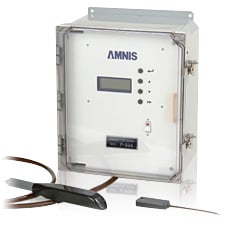
Water Level Flow Monitor
The pressure-type water level/flow meter (WDM-1X) was developed as a flow meter for open channels such as sewers, and converts the water level signal sent from a pressure-type water level sensor installed in the measurement channel into a flow rate based on programming.The water level and flow rate are displayed on an LCD and output to the outside as an analog signal and an integrated pulse signal (optical MOSFET). In addition, limit alarms can be set by programming and output as relay contact signals.*High-precision flowmeter for sewer pipes Construction Technology Evaluation Regulations (former Ministry of Construction) Evaluation Product (Construction Technology Evaluation No. 88301)
Main function
1. Calculate the flow rate from the water level
2. Display of water level and flow rate values
3. Display of flow rate total
4. Limit alarm status display
5. Water level and flow rate analog output
6. Flow rate totalizing pulse output
7. Limit alarm output
8. Watchdog Output
9. Programming (Setup)
10. Water level calibration and output test using software
specification
Measurement target
General sewage, rainwater, industrial wastewater, agricultural water, river water, etc.
Main unit
| Main material | Made of resin |
| size | W345×H421×D202 (cable lock and latch not included) |
| display | LCD (20 full-width rows x 4 columns) |
| Ambient temperature | 0 to 50°C (however, avoid direct sunlight) |
| Ambient humidity | 25 to 95% RH (no condensation) |
| attachment | Rear mounting type (recommended for installation inside the panel) |
sensor
| Main material | Made of urethane resin |
| size | W34.5×H32×L203 |
| Measuring part | SUS316 diaphragm type |
| range | 3.5m, 10m |
| pressure resistance | 3.5m range: 14m, 10m range: 42m |
| accuracy | 3.5m range: ±2% (relative to actual water level) ±3mm10m range: ±2% (relative to actual water level) ±10mm |
| Dedicated cable | Standard 30m |
| Ambient temperature | 0 to 50°C |
| attachment | Fixed to the bottom of the waterway using dedicated mounting brackets (standard) |
Flow Measurement Accuracy
±3% FS (when combined with PB flume, etc.)
Analog Output
| score | Standard 2 points (maximum 3 points, selectable from water level and flow rate) |
| kinds | DC4~20mA (maximum load resistance 1000Ω) |
Flow Pulse Output
Optical MOSFET (withstand voltage 200V, load current 150mA)
Contact Output
| Contact Capacity | Relay contact (DC24V 1A, AC110V 0.5A) |
| kinds | Limit alarm (2 points): Selectable from water level or flow rateWatchdog pulse: Output when malfunction occurs due to some cause |
program
| Display content | Water level/flow rate or limit alarm status |
| set up | Waterway shape, parameters, various outputs |
| Parameters | PB Flume, Seki, Manning formula, Parshall Flume*Special calculations require separate ROM creation. |
power supply
AC100V 50/60Hz, power consumption 20W
Body mass
Approximately 7kg
Related Equipment
JIS compliant products (planned: JIS B 7557 Drainage flowmeters - for trade or certification ), portable electromagnetic flow meters, portable surface velocity/PBF flow meters, rectifiers (baffles, blocks, etc.), flow monitoring systems (packet communications, cloud, regional IP networks, telemetry, etc.), IoT compatible
Measurement principle
The water level is detected as water pressure by a diaphragm pressure transducer at the bottom of the sensor. A pressure-receiving element whose resistance changes with pressure changes is embedded inside the transducer, and the change in resistance is amplified as a change in voltage and output to the converter. The sensor cable has a built-in air tube, and the transducer is compensated for atmospheric pressure.The water level voltage signal output from the sensor is processed as a measured water level by the converter, and the flow rate corresponding to this water level is calculated according to the program. The calculated flow rate is converted into an analog signal along with the water level and can be output externally, or it can be converted into a pulse signal for flow rate integration and output.
Installing the sensor
The sensor is generally fixed to the bottom of the measurement channel using a dedicated mounting bracket.