
PBF (Perma-Bolus Flume) critical flow meter
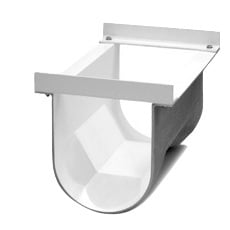
PALAMER BOWRUS FLUME
The Perma-Bolus Flume (PBF) was developed as an open channel flow meter for use in sewer systems, among other applications.PBFs have a narrowed channel shape, and the flow velocity increases at the narrowed section, changing the flow conditions. At this point, a special flow state known as "critical flow" occurs at the narrowed section, and it is known that in this flow state, the flow rate can theoretically be determined from the water level.PBFs are called critical flow flowmeters because they generate critical flow to measure flow rate.*High-precision flowmeter for sewer pipes Construction Technology Evaluation Regulations (former Ministry of Construction) Evaluation Product (Construction Technology Evaluation No. 88301)
Features
- Shape suitable for measuring flow rate in sewer pipes
- Change the flow state from normal flow to critical flow to supercritical flow
- Water level measurement in the upstream area where the flow is stable (regular flow area)
- Self-cleaning effect that prevents sludge accumulation upstream
- A split assembly type that can be carried in through an existing manhole
specification
Measurement target
General sewage, industrial wastewater, agricultural community wastewater, reduction certification (reduction/exemption), etc.
Main unit
| Main material | FRP: Invert type, permanent type SUS: Invert type, permanent type, round type (installed inside pipes) |
option
Upstream waterway (U-shaped waterway or VU pipe, etc.)divided assembly typeFlow rectifiers (baffles, blocks, etc.)
Flow Measurement Accuracy
±3% FS*When used in combination with a pressure-type water level/flow meter (WDM-1X) and a submersible ultrasonic water level/flow meter (F-304)
Installation method
Fixing with concrete (mortar) or metal fittings
principle
In an open channel, when considering the flow state under the condition of constant energy for a certain flow rate, two states can be considered: subcritical flow (flow where the flow velocity is slower than the propagation speed of surface waves) and supercritical flow (flow where the flow velocity is faster than the propagation speed of surface waves). In a PBF, the constricted part acts as flow resistance, so the flow slows down upstream and becomes subcritical flow. At the constricted part (throat), the cross-sectional area of the flow becomes smaller, but because the flow is continuous, the flow velocity increases and the downstream side becomes supercritical flow.Between the subcritical flow upstream of the PBF and the supercritical flow downstream, i.e., in the throat, an intermediate flow known as "critical flow" occurs. Critical flow is the flow with the minimum energy for a certain flow rate, and hydraulically, the flow rate can be determined from the water level. However, it is difficult to measure the water level of critical flow, so the flow rate is actually obtained by measuring the water level upstream and relating it to the critical flow level.Generally, the upstream side of the PBF must have a straight channel length of the same diameter as the PBF, which is at least 5 to 10 times the diameter of the PBF. It must also be installed so that it is not affected by backwater from downstream.